Nariman El Chamaa, journalist. President of Donia for Sustainable Development
Between the legacy of patriarchal concepts and legislative gaps.
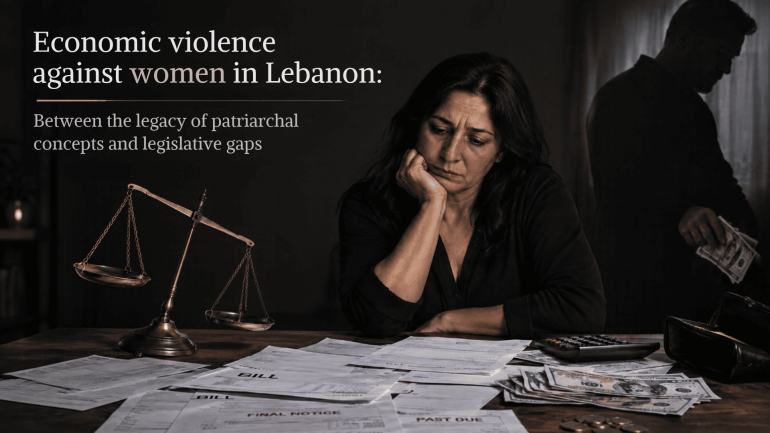
When violence is discussed, bruises on bodies are typically what first come to mind—overlooking the reality that the most severe forms of oppression are those that leave silent scars on pockets, daily bread, and human dignity. Economic violence against women and girls remains the least visible yet most destructive facet of gender-based violence. Amid the compounding and successive crises paralyzing Lebanon, women’s living vulnerabilities are magnified, leaving the Lebanese woman trapped between the anvil of financial subjugation and the hammer of marginalization.
The latest Global Gender Gap Report by the World Economic Forum places Lebanon at a dismal global rank (128th), while data from the International Labour Organization (ILO) and the World Bank confirm that women’s national labor force participation remains strikingly low, lingering between 22% and 23% compared to over 63% for men.
Patriarchal Legacies and Stereotypes: Exclusion Behind the Walls of “Traditional Professions”
Along the pathways leading to the future, patriarchal legacies embedded within certain segments of society stand as invisible barriers obstructing women’s progress. These norms bar them from entering non-traditional sectors—such as technology, mechanics, and security—while restricting their ambitions strictly to stereotypical, traditional roles like teaching, nursing, tailoring, and hairdressing. This systematic stereotyping does more than merely limit a girl’s choices; it institutionalizes absolute economic dependency and deprives women of keeping pace with the digital and professional revolution.
Deprivation does not stop there; rather, it extends deep into the informal (unstructured) economy, where labor market surveys conducted by the ILO reveal that a massive proportion of working women toil under conditions devoid of job security, social protection, or health coverage. Compounding this is the invisible drain of “unpaid care work,” where women shoulder the heaviest burdens of family and domestic care—as if their energy is an infinite, unacknowledged resource meant solely to perpetuate dependency.
Workplace Harassment: A Weapon of Financial Exclusion and Career Displacement
Sexual and psychological harassment in the workplace cannot be detached from the broader framework of economic violence; in fact, it serves as one of its most lethal instruments, robbing women of their financial autonomy. In the absence of robust internal protection policies across many businesses and institutions, female workers are often forced to choose between two bitter options: enduring a hostile, toxic environment stripped of dignity, or opting for forced resignation and complete withdrawal from the labor market to escape abuse and social stigma. Workplace harassment does not merely shatter a woman’s psychological and personal safety; it derails her career trajectory, denies her promotions and financial entitlements, and deprives households of vital income—causing direct financial drain while exacerbating female unemployment and poverty.
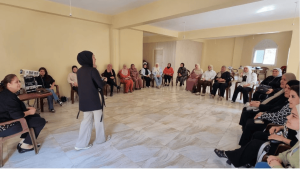
Awareness session on economic violence against women working in the informal sector
The Labyrinth of Tax Discrimination and Social Security: Between Formal Equality and Shadowy Loopholes
On the financial and legal fronts, the reality is governed by a complex duality. While explicit gender-based discrimination has theoretically been dismantled through a flurry of recent laws and memos—such as Law No. 180/2011 on tax deductions and social security amendments up to 2024 that established equality for female employees and introduced the concept of the “partner” (covering both husband and wife)—these reforms continue to crash against deep structural disparities:
• Enshrined Legal Gains: Employed women are now entitled to tax deductions for their husbands and children (with family deductions for children split equally at 50% between working spouses), and the National Social Security Fund (NSSF) formally equates genders in covering sickness, maternity, and family allowances based on actual dependency.
• Indirect Discrimination and Vulnerable Groups (Widows and Divorcees): Despite the equality afforded to employed women, severe legislative flaws emerge when dealing with other categories. For instance, an unemployed mother (whether a widow or a divorcee) cannot be registered under her employed children’s health insurance in the NSSF unless she turns 60 or suffers a severe disability—whereas the law grants fathers much greater flexibility. Furthermore, women face stubborn bureaucratic hurdles and arbitrary obstacles during social investigations and dependency-proving procedures at administrative and NSSF offices.
Legislative Loopholes: When the Protective Umbrella Falters
Despite the enactment of progressive legislative steps in recent years—such as Law No. 293 on domestic violence protection and Law No. 205 of 2020 criminalizing sexual harassment—the national legal framework remains plagued by glaring gaps:
• The Shortcomings of Lebanese Labor Law: Large segments of workers, such as domestic workers, agricultural laborers, and informal workers, remain entirely excluded from comprehensive protection, retirement guarantees, and fair compensation.
• Enforcement Paralysis and Languishing Litigation: The weak efficacy of labor arbitration councils and sluggish judicial procedures leave abused women vulnerable to exhausting financial and psychological attrition whenever they attempt to reclaim their basic rights.
A Lifeline: Toward a Comprehensive National and International Strategy
Confronting economic violence in Lebanon is no longer an intellectual luxury; it is a vital lifeline demanding a holistic national strategy that transcends seasonal, cosmetic fixes. Its primary pillars include:
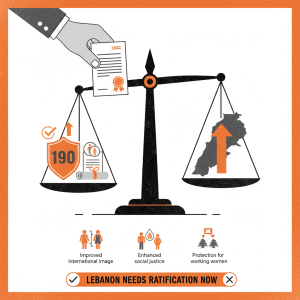
1. The International Window: Accelerating the ratification of International Labour Organization Convention No. 190 (ILO C190) and its accompanying Recommendation No. 206, establishing a clear roadmap to eradicate violence and harassment in the world of work.
2. Dusting Off National Legislation: Amending the Labor Code, social security laws, the Income Tax Law, and the Penal Code to guarantee absolute wage equality, explicitly criminalize economic violence, and secure a safe national work environment that preserves human dignity and safeguards women’s independent futures.
Economic independence is not a privilege granted by societies to women at their whim, but an inherent human right. When a woman is empowered to learn, work, own, and decide freely, she achieves more than personal autonomy—she active contributes to building a more productive economy and a fairer society for all.