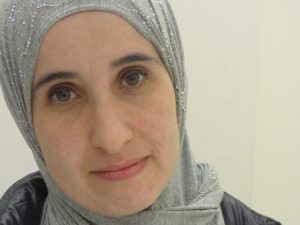
Lana Kazkaz, Journalist
Photo: Lina Alhafez. Damascus, Hijaz Square, December 15, 2024
For half a century, brave Syrian women have placed themselves at the heart of political and social life, defying cultural restrictions and male dominance that have historically limited their roles.
One of the pioneers was Thuraya Al-Hafez, an educator and activist who, in the 1950s, entered the Syrian Parliament with a clear speech advocating for women’s rights and their participation in the public sphere. Her presence was a revolutionary act in a male-dominated political structure.
Later, Najah Al-Attar stood out as the first Minister of Culture, who—despite being appointed under the Ba’athist regime—represented an exception in a system that rarely viewed women as power figures. Also essential to mention is Fadwa Suleiman, an actress and opposition figure, whose participation in the early protests of the revolution made her a symbol of the connection between the struggle for freedom and gender justice.
These stories are a testament to the fact that Syrian women have never been absent from the political process, although their visibility has often been reduced to isolated or symbolic cases within a rigid system of hierarchies and gender roles.
Today, with Bashar al-Assad’s flight in December 2024, Syria faces a critical juncture to rebuild its state and redesign its institutions. The big question: will women be part of this process of political transformation? Or will they continue to be excluded from decision-making spaces?
The current transitional administration, led by Ahmad al-Shar’a, has 23 ministries. Only one is headed by a woman. This figure, beyond its numerical value, reflects the structural exclusion of women from political power, despite the vital role they played during years of war, activism, humanitarian aid, and social resistance.
During the conflict, Syrian women organized protests, provided medical care, documented human rights violations, and built support networks for the displaced. Yet these contributions have not translated into tangible political representation. Decision-making remains in male hands, even after the supposed “change” of regime.
Abroad—particularly in the Syrian diaspora in Europe, Turkey, and Lebanon—many women have achieved leadership positions in politics, human rights organizations, social initiatives, and academic and cultural fields. They have demonstrated capacity, vision, and significant influence on Syrian issues and in their host communities.
Thus, the inevitable question arises: if women in the diaspora can lead movements, build institutions, and actively participate in decision-making, why isn’t this success replicated inside Syria? What barriers continue to prevent women from fully integrating into national politics?
The answers are multiple and complex. They include deeply rooted social traditions, exclusionary power structures, and a real lack of internal and external political will to implement reforms that guarantee substantive equality. But without women’s participation in the country’s reconstruction, the process will remain incomplete, and aspirations for social justice will remain unmet.
Moreover, issues such as reforming family law—which openly discriminates against women—or guaranteeing their economic and social rights, continue to be postponed or dismissed as secondary in the face of security and stability-centered agendas.
The real question is: will political change in Syria be a radical transformation that challenges existing power structures, or simply a superficial replacement that leaves the exclusionary model intact?
Building a new Syria requires much more than the end of an authoritarian regime. It demands dismantling the mechanisms that have historically marginalized half the population. Women cannot be seen as a symbolic quota but as essential actors with experiences, knowledge, and proposals that are indispensable for an inclusive and just national project.