


Leonor Pérez-Durand, Journalist TeleoLeo.com
In recent years, violence against women has only increased. This is a symptom of a patriarchal capitalist society where all forms of violence are reproduced in the bodies of women, children, dissidents, and those who disobey—bodies on which men fulfill the mandate of masculinity, which is nothing more than a demonstration of power, strength, of taking by force those considered objects of pleasure and property, and to this end they are capable of acts of cruelty that can reach the highest level of violence: suppressing the life of those who oppose their designs, those who rebel.
That is why neither social condemnation nor punitive justice are achieving their goal of ending violence against women, children, and vulnerable people, because the men who commit these acts are themselves victims of the beliefs instilled in them from birth: men do not cry, they do not express their feelings, because that is something girls do, and at the same time they are taught that they must be strong, competitive, providers, conquerors, that they must be successful and, in order not to upset the established order, they must always earn more than a woman, than their wife; at the same time, we women are educated in service and submission.
Nothing said here should be understood as exonerating cruel men, but it has been proven that criminal punishment does not deter them from causing harm. Imprisoning an aggressor, a femicide perpetrator, does not solve the problem; it only addresses the effect, not the cause. Therefore, until there is a paradigm shift in education and socialization that breaks with gender mandates, we will continue to produce aggressors and victims.
Gender violence: the iceberg and the politics of cruelty
When we talk about gender violence, we are talking about femicide, physical, sexual, or psychological abuse; about broken childhoods torn away from their protective figures, their mothers, or about children murdered by their fathers to punish disobedient women who broke with imposed submission. This policy of cruelty against the most vulnerable is also being carried out by minors through bullying, but also through sexual assault, which is leading to suicides. This shows us not only that violence must be neutralized from the base of the well-known iceberg, but also from early childhood through education and the empathetic and loving socialization of children.
Among the types of gender-based violence that we focus on most are those that leave marks, those in which blood and bruises bear witness, and among those we notice least when we read the statistics are economic and institutional violence. However, these expressions of gender-based violence, because of their impact on women’s lives, are nonetheless extremely important.
“Without institutional violence, there would be no gender violence.”
This statement comes from a mother who was a victim of vicarious violence, and she knew what she was talking about. She had reported her ex-partner for various acts of violence and lost custody of her children because they did not want to visit the aggressor. He sued her, she was convicted of false parental alienation syndrome (PAS), and she lost custody of her children, who were placed in a juvenile center. As a result, her 13-year-old daughter attempted suicide, but the children’s father does not care. He remains adamant that his children should remain away from the only person who has always protected them, their mother, and patriarchal justice supports him.
PAS is not recognized by international organizations such as the WHO, and the UN has called Spain’s attention for using it in its court rulings through euphemisms such as: the mother manipulates, the mother exploits, accusing her because the children refuse to maintain a relationship with the person who abused their mother and, consequently, themselves, as stated in Organic Law 1/2004 of December 28 on Comprehensive Protection Measures against Gender Violence. The use of PAS in court rulings is always against mothers and therefore reinforces institutional violence against women’s bodies.
Institutional violence affects us every time we file a complaint and are met with mistrust. Historically, our bodies, our appearance, and our attitudes have been a constant source of suspicion; we have always been the witches, the liars, or the deceivers. This disbelief is due to the fact that our forms of expression and our voices are alien to the codes of power. This happens even when the person exercising that power is another woman, because in order to maintain the authority she has achieved, she is forced to assume the forms and voice of the patriarchy, transvesting herself internally and externally to demonstrate her alignment with the established order.
The silence of the figures: fear and judicial revictimization
According to the website Feminicidio.net, as of November 4 this year, there have been 75 femicides, with an average of eight women murdered each month because they are women. In 2024, there were 95 recorded cases, repeating the trend of eight femicides per month; these figures include Spanish women and migrants.
According to a study by the Ministry of Equality between 2003 and 2017, 32% of women murdered because they were women were migrants, refuting the rumors spread by the patriarchal far right: 69% of murderers were Spanish, with the remaining 31% being foreigners.
If we look at reports of gender-based violence, according to the General Council of the Judiciary (CGPJ), 199,094 were filed in 2024, and the upward trend continues: in the quarterly comparison, 50,536 complaints were registered up to the second quarter of 2024, a figure that rose to 50,737 in the same period of 2025.
Figures from the Ministry of Equality confirm that, despite all the laws and increased penalties, far from ending violence against women, since 2016 to date, cases of gender-based violence have increased by almost 100%, as while 52,635 were recorded in 2016, so far in 2025 there have already been 104,981.
Fear and judicial revictimization: withdrawing complaints to avoid further harm
Ruth is a woman with autism who reported her partner for sexual assault, claiming that after she gave birth, he forced her to have sex, even with their baby sleeping in the same bed. During the separation process, her lawyers advised her to withdraw her complaint in order to reach an agreement with the alleged abuser regarding custody of their young daughter. “They told me that if I testified against him, he would request joint custody, and I couldn’t allow that because I was still breastfeeding my daughter.”
Since the opening of the process for gender-based violence, the number of women who decide to exercise their right not to testify is on the rise. According to figures from the CGPJ, 4,603 women decided not to testify in the second quarter of 2024, and so far in 2025, 5,549 have followed suit. This is due to fear of reprisals, not having the means to become independent from the aggressor, having reached an agreement to avoid disputes over custody of the children, or not wanting to submit to the violence of a system that does not give credibility to their stories and revictimizes them with judicial and administrative reports that are usually unfavorable to them.

Between 2024 and 2025, more than 6,000 victims did not receive protective measures
“I was not given protective measures, even though my abuser, the father of my daughters, is in the military and was always armed. When he assaulted one of my daughters and I reported him again, even providing a video showing him pulling her because she didn’t want to go with him, the judge said that all he could see in the images was a father making his daughter obey him.”
By the second quarter of 2024, 10,604 protective measures had been requested in gender-based violence courts, of which 3,503, or 33%, were denied. In the same period of 2025, 10,588 protective measures were requested, which is 0.15% less than in the same period of 2024, and 3,462 were denied, or 33%, the same as in the same period of 2024.
In absolute terms, so far in 2025, 6,416 protection measures have been granted to Spanish women and 4,109 to foreign women, which reflects a high level of vulnerability among victims, because there are 28,958 Spanish women who have filed complaints and 17,592 migrant women. In the case of migrants, the situation is even more bleak because, in most cases, without family, without legal status, and without financial resources, when they report abuse, they become even more vulnerable to their aggressors.
Unprotected childhood
The bond between parents and children is always defended in Spain’s patriarchal system. Although the law considers the children of victims of gender-based violence to be victims themselves, it is not common practice to issue restraining orders between parents and children. So far in 2025, despite thousands of complaints from women, many of whom are mothers, and despite three children having been murdered by their fathers or their mothers’ partners in order to harm them, which we refer to as vicarious violence, only 65 criminal protection orders and 42 civil protection orders have been granted to minors. Criminal orders are extended until the case is decided, while civil orders have a more limited duration. Paula, the mother of two girls, is one of the complainants who has not obtained protective measures for her daughters.
“I lost custody of my daughters after separating from their father due to abuse, and because they didn’t want to see him, he reported me, I was accused of false parental alienation syndrome, I lost custody, and I was given visitation rights at a family meeting point. After a while, he assaulted my eldest daughter. Despite the bruise on her eye, the judge considered that it was not an assault but a corrective measure. Some time later, my daughter recorded her father threatening to kill her, and I got her back, but my youngest daughter still has to continue living with him.”
Layers of victimization: woman, migrant, and racialized
Regarding the nationality of the complainants, another important piece of data from the CGPJ is that complaints of gender violence filed by migrant women represent 38% of the total, while according to figures from infoextranjería.org, they make up only 11% of the female population in the country. And while this figure is worrying, it is not accurate, as many migrant women, not having regularized their documents or fixed incomes, do not report incidents out of fear and so as not to lose the roof over their heads, thus suffering several layers of victimization: as women, as foreigners, and as racialized individuals. This can be deduced from the MIGRADAS report: migrant women facing gender-based violence, according to which 63% of migrant women have suffered violence.
Migrant women who are victims of gender-based violence also suffer institutional violence through the removal of their children by the authorities, because when economic vulnerability leads them to become users of social services, their lives are scrutinized in minute detail and in many cases, instead of providing them with the means to get ahead with their children, their children are taken away from them by means of neglect orders, losing their custody or guardianship to be placed in residential centers or handed over to foster families. This is what happened to Angela, a Chinese woman, but it also happens to many others.
“I reported my husband for beating me, I separated from him and was left alone with my two children. As I needed to work, I went to social services to ask for help in finding somewhere to leave my children for a few hours. There, they made me sign a document that I didn’t even know what it was because at that time I knew very little Spanish and could only speak it. What I had signed was a temporary custody order, which later became an abandonment order. They took my children away, separated them, and placed them with two different foster families. Now they don’t even speak our language anymore.”
The failure is structural: inventory of a system that punishes victims.
For thousands of women, the path to reporting abuse is an institutional ordeal that, far from offering protection, imposes new layers of pain. The 5,549 silences of victims who do not report, the protection orders that are not issued, and the cases of migrant and vulnerable women who are robbed of motherhood because of their impoverishment and lack of support networks are the most painful proof that no matter how many progressive laws we have, they will continue to crash against a judiciary that operates under the logic of patriarchy: the logic of power and cruelty.
In this apocalyptic phase of capital, as feminist anthropologist Rita Segato calls it, sexist violence is portrayed in the desire for “ownership,” to demonstrate possession and disposal at will of women’s bodies and the fruit thereof. By failing to protect, the system confirms the aggressor’s dominance, and as long as the focus remains on punishment, on individual punishment, on a lack of analysis and awareness, and does not center on deconstructing the mandate of masculinity, on abolishing the system of cruelty imposed by patriarchy, justice and institutions will continue to revictimize women, children, dissidents, and those who disobey. As long as we continue to believe that the solution to gender-based violence is individual and leave the burden of its elimination to legislation, femicides, assaults, and revictimization will continue to demonstrate, every day, the structural failure and lack of empathy in our society.


Related Articles
-

Norma Falconi: “Our fight is for migrant feminism to be recognised, within the demands of the feminist movement”
-

The journalist Sylvie Luzala denounces that in the Democratic Republic of the Congo “most media do not talk about women”
-

Gender and Political Reform in Syria after Al-Assad: Is There Real Participation of Women?
-
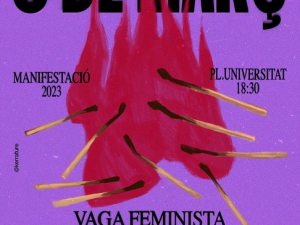
Manifesto March 8 of the Assembly8M.Cat