Sally S. Tayie, journalist and researcher
In the bustling streets of Cairo, the villages of Upper Egypt, and across millions of smartphone screens, Egyptian women are navigating a society undergoing rapid digital transformation. They are entrepreneurs, educators, journalists, caregivers, content creators, and community leaders. Increasingly, they are visible in public life and are playing a growing role in Egypt’s social and economic development.
Yet visibility does not always translate into empowerment.
Despite significant progress, many women continue to navigate deeply rooted stereotypes about what women should do, how they should behave, and where they belong. Increasingly, these stereotypes are no longer transmitted only through traditional social structures. They are reproduced, amplified, and sometimes weaponized through digital media.
This is why Media and Information Literacy (MIL) has become far more than an educational concept. For Egyptian women today, it is a prerequisite for participation, empowerment, and agency in a digital society. At its core lies the pursuit of media justice—the idea that women should be represented fairly, participate equally, and engage safely in media and digital environments. Media justice is not only about access to information or technology; it is about the ability to recognize bias, challenge harmful stereotypes, protect oneself from digital harm, and actively shape public conversations.
For decades, women’s empowerment was framed around access to education, employment, and political participation. These remain essential. But digital technologies have added a new layer: the ability to critically access, evaluate, create, and share information.
In Egypt, where more than 51 million social media identities are active and internet use continues to grow, digital platforms have become central spaces for communication, learning, commerce, and civic engagement. Yet women remain less visible than men across many platforms despite representing nearly half the population, particularly in spaces where public debate is shaped.
This matters because digital spaces are not neutral. They shape perceptions, reinforce norms, and influence opportunities.
Women today are exposed to vast flows of information, but also to misinformation, manipulation, online harassment, and distorted representations of gender roles. In late 2025, the Al-Azhar Observatory for Combating Extremism warned that digital violence has become one of the fastest-growing forms of violence affecting women and girls in the region. It reported that 60 percent of Arab women internet users have experienced some form of online violence or harassment, ranging from cyberstalking and defamation to deepfake manipulation. These figures highlight a critical reality: digital participation must be accompanied by digital safety and awareness.

A young woman scrolling through social media may encounter misleading health advice, harmful beauty standards, AI-generated content, or narratives that limit women’s aspirations and roles. The challenge is not access to information, but the ability to question, interpret, and evaluate it critically.
Across classrooms, workplaces, and online spaces, questions about misinformation, digital safety, artificial intelligence, and online participation are becoming increasingly central to everyday life. The challenge today is not simply exposure to information, but the capacity to navigate it critically and confidently.
The answer lies not in restricting access, but in strengthening competencies.
Media and Information Literacy equips women with the ability to recognize misinformation, identify biased representations, verify sources, understand how algorithms shape what they see online, and protect their privacy and digital identities. It transforms individuals from passive consumers of information into active participants in the digital ecosystem.
In this sense, MIL can be understood as a form of digital self-defense. It enables women not only to question information, but also to navigate online spaces safely, identify manipulative content, recognize coordinated harassment, and make informed choices about their digital presence. Rather than retreating from digital spaces, women can engage with them more confidently and strategically.
Importantly, MIL is also an economic enabler.
This connection between digital competencies and empowerment is increasingly recognized in Egypt’s broader development vision. The National Strategy for the Empowerment of Egyptian Women 2030 identifies women’s political, economic, social, and protective empowerment as essential pillars of sustainable development. Central to this vision is enabling women to make informed choices, expand their participation in society, challenge discriminatory practices, and realize their full potential. In an increasingly digital world, these objectives are inseparable from the ability to access, evaluate, and use information critically.
Across Egypt, women are increasingly using digital platforms to market products, launch businesses, reach customers, and access professional opportunities. Digital entrepreneurship has opened new pathways for financial independence. Yet meaningful participation in the digital economy requires the ability to assess online opportunities, detect scams, understand platform dynamics, and manage digital risks.

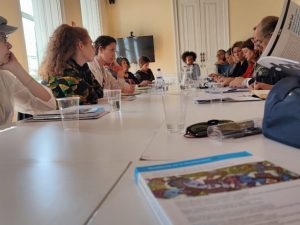
Source: UNESCO Media and Information Literacy (MIL) Workshop for Women, Cairo, Egypt. Photo by the workshop organizers.
MIL therefore functions not only as protection, but also as opportunity.
It also has a civic dimension. Information-literate women are better equipped to engage in public discourse, challenge discriminatory narratives, and participate in discussions that shape their communities. They are also more capable of recognizing and resisting digital violence, including cyberbullying, harassment, and sophisticated forms of manipulation such as deepfakes.
This is particularly significant in a region where women are increasingly contributing to economic development, innovation, education, and public life. Digital transformation expands opportunity, but only for those equipped to navigate its complexity.
Media and Information Literacy therefore represents a hidden infrastructure of empowerment. It may not be as visible as economic reform or technological investment, but it underpins both. Without it, digital access is insufficient. With it, women gain the capacity to navigate complexity, seize opportunities, and shape their own futures.
As Egypt continues its digital transformation, Media and Information Literacy should no longer be treated as an optional skill. It is part of the infrastructure of empowerment itself.
Because behind every online decision—every shared post, every search, every moment of doubt about what is true or false—there is a woman making sense of a rapidly changing world while trying to protect her place within it.
An educated woman can access information. A media and information literate woman can question it, interpret it, and use it to expand what is possible for herself and for others around her.
In an age defined by information, empowerment depends not only on being connected—but on being able to think freely within that connection.